How I Built a Yoga Schedule Around School Hours
When my children started school full time, I realized something very quickly: staying at home did not mean I suddenly had endless free hours.
What it gave me was structure. School hours became the frame of my day, and everything else had to fit inside that frame if I wanted my life to feel calm instead of constantly rushed.
I teach yoga because I love it. I also earn my own money from it, which matters to me.
At the same time, I am a mother first, and I care deeply about being present for my children before and after school.
Building a schedule that respected both took time, mistakes, and a lot of honest observation about how my days actually unfolded.
Starting With the Reality of Our Mornings

Our mornings begin early, but not quietly.
Between getting three children ready, preparing breakfast, packing lunches, checking backpacks, and making sure everyone leaves the house in one piece, the energy is already high by 8:00 a.m.
School drop-off usually happens around 8:30 a.m., but that does not mean I am immediately ready to work afterward.
I learned early on that scheduling anything before 9:30 a.m. was unrealistic for me. I need time after drop-off to reset the house, change into teaching clothes, drink water, and mentally shift from mother mode to instructor mode.
When I tried to teach at 9:00 a.m., I felt rushed, unfocused, and slightly irritated, which is not the energy I want to bring into a yoga session.
So I made a firm rule for myself: no teaching before 9:30 a.m. That single decision removed a lot of pressure.
Defining My Actual Teaching Window
School pick-up is around 3:00 p.m., but I never schedule sessions up until that time.
I need a buffer. I want to arrive at pick-up calm, not watching the clock or mentally finishing cues from a class.
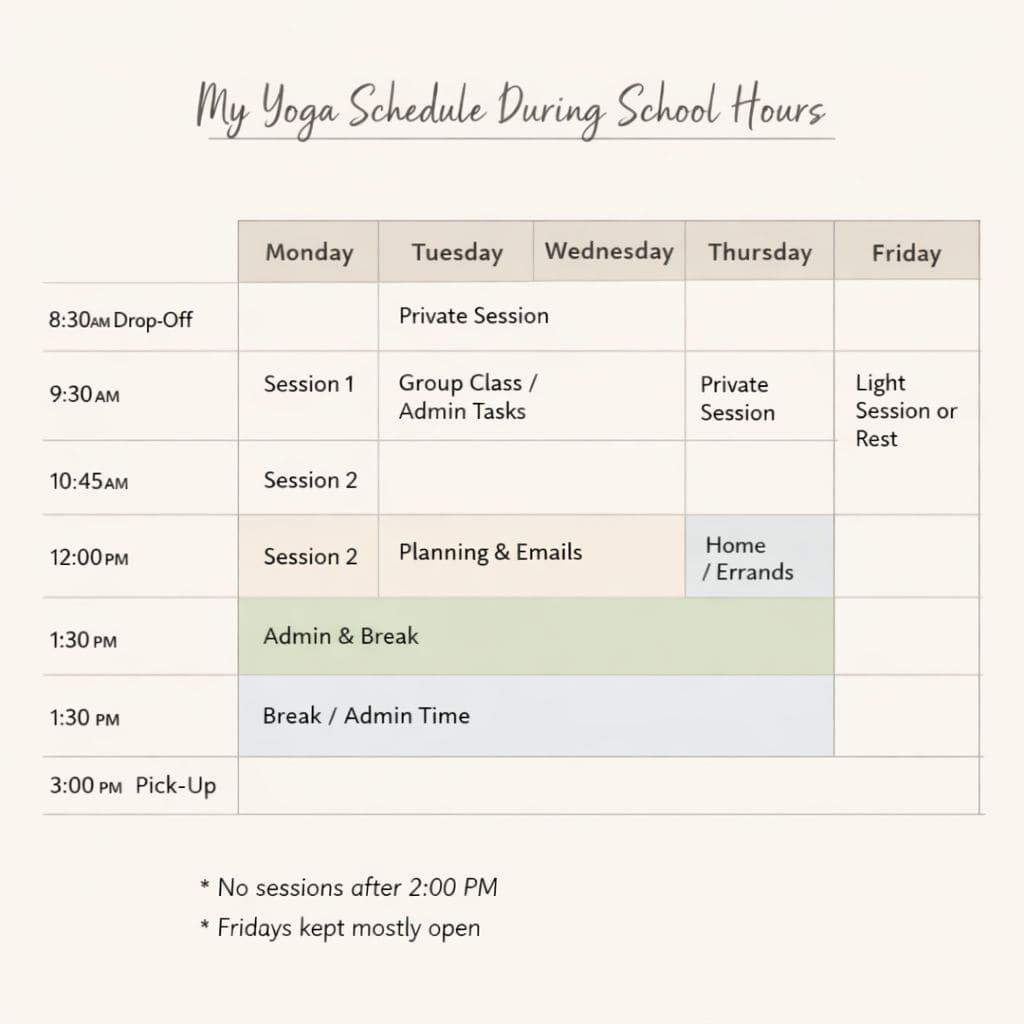
After testing different options, I settled on a teaching window from 9:30 a.m. to 2:00 p.m. That gives me about four and a half hours to work, but I do not fill all of them with sessions.

On a typical day, I teach two to three private sessions, each lasting 50 minutes. Occasionally, I’ll add a short group class, but never more than one per day.
Between each session, I leave 15 to 20 minutes completely unscheduled. This time is not optional. It’s when I hydrate, stretch, write brief notes, respond to messages, or simply sit quietly.
When I didn’t leave space between sessions, I noticed physical fatigue building up in my shoulders and voice by early afternoon.
Teaching yoga may look gentle from the outside, but it requires attention, emotional presence, and steady energy. So, the breaks protect that.
Organizing My Week, Not Just My Days
Another important change was stopping the habit of doing everything every day. Instead, I organized my work around the week.
Mondays and Wednesdays are my main teaching days. These are the days when I schedule most of my one-on-one clients. I usually teach three sessions on these days, starting at 9:30 a.m., 10:45 a.m., and 12:00 p.m.
Tuesdays are lighter. I often schedule one group class or one private session, and I use the rest of the time for admin work, planning, or rest.
This day also allows flexibility if one of my children has an appointment or needs extra attention.
Thursdays are mixed. Some weeks I teach two sessions. Other weeks, I don’t teach at all and focus on home responsibilities, grocery shopping, or personal practice.
Fridays are intentionally slow. I rarely teach on Fridays. If I do, it’s one short session in the late morning.
I learned that ending the week gently helps me stay patient and present going into the weekend.
This weekly rhythm keeps me from feeling like I’m constantly catching up or overworking myself.
Clear Rules I Set for Clients and Myself
One of the most important steps was setting non-negotiable boundaries and sticking to them.
I do not teach early mornings, evenings, or weekends. I do not schedule sessions during school pick-up hours. I do not offer last-minute availability unless I genuinely have the space for it.
When new clients contact me, I explain my availability clearly from the beginning. I don’t apologize for it.
I’ve found that people who respect my time tend to become long-term clients, while those who push for exceptions usually create stress later on.
This clarity has made my work feel stable instead of reactive.
Managing Housework Around Work Hours
Staying at home does not mean the house takes care of itself while I work. At first, I tried to squeeze housework in between sessions, but that only left me feeling distracted and unfinished.
Now, I treat my teaching hours as real work hours. I do light tidying in the morning and save deeper cleaning, laundry, and errands for days when I teach less or not at all.
Cooking usually happens after pick-up, when I’m already in family mode again.
Separating work time from house time helps me stay focused and prevents burnout.
This Schedule Works for Me
This structure allows me to earn money doing something meaningful while still being available to my children when they need me most.
I don’t feel torn between roles as often. I know when I’m working and when I’m not.
More importantly, it feels honest. I am not pretending I can do everything at once. I am choosing what fits into my real life.
For women who want to balance caring for children with doing work they love, especially something like yoga instruction, I believe structure matters more than motivation.